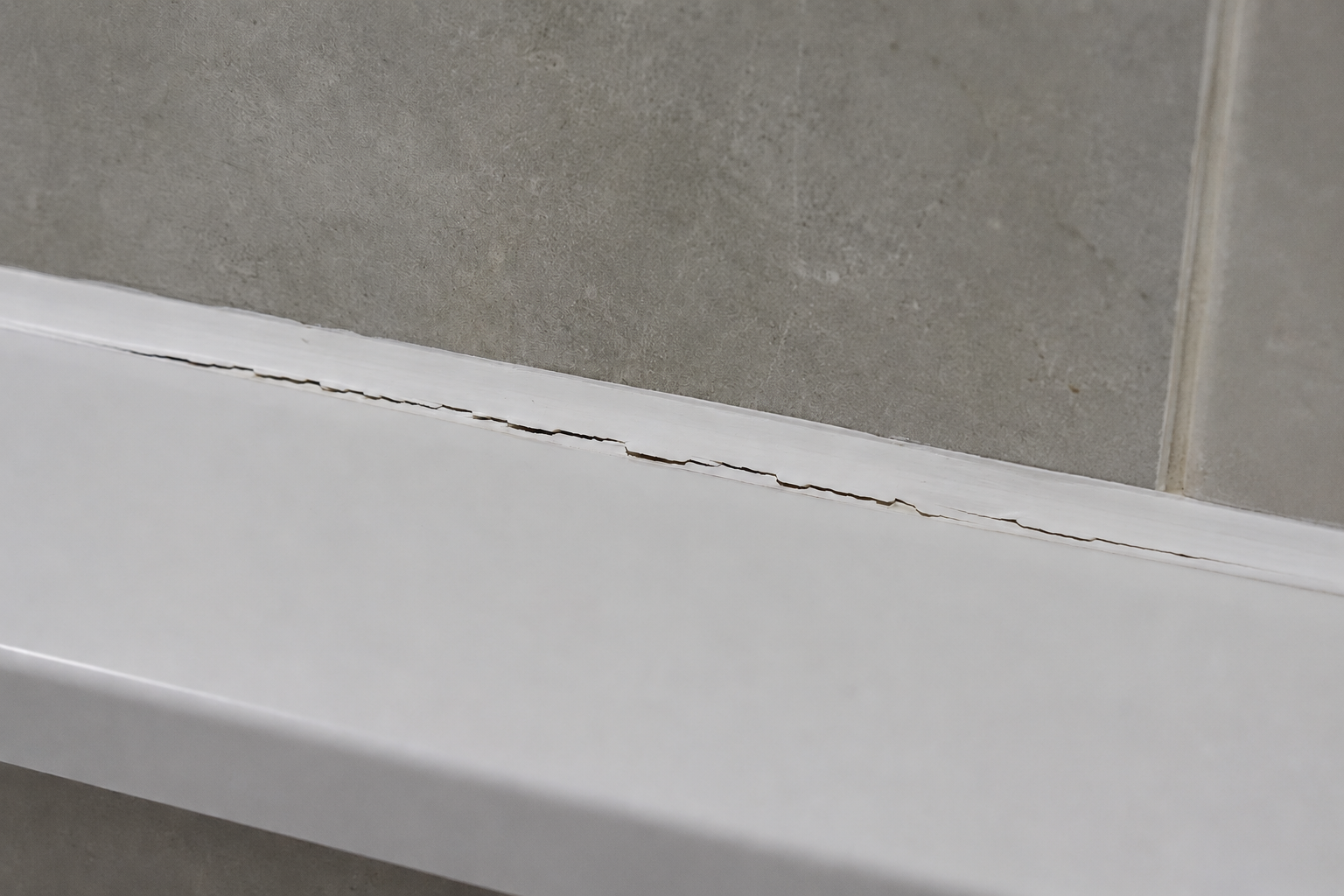
Why is my silicone sealant cracking?
Cracks in silicone sealant are usually caused by stresses in the joint or by choosing the wrong sealant.
Possible causes of cracking silicone sealant
Incorrect sealant for the application
- If a silicone sealant is not sufficiently elastic, cracks may appear on moving substrates.
Curing too quickly
- When silicone sealant cures too quickly, stresses can arise in the material that later cause cracks. Therefore, avoid applications on wet substrates.
Failure to respect joint dimensions
- Respecting the correct joint dimensions is essential to prevent cracks, poor adhesion and stresses in silicone sealant.
-
Joint width Joint depth Permitted difference 3-4 mm 3-4 mm 1 mm 6 mm 6 mm 1 mm 8 mm 8 mm 1 mm 10 mm 6-8 mm 2 mm 15 mm 10 mm 2 mm 20 mm 10-12 mm 2 mm 25 mm 15 mm 3 mm 30 mm 18 mm 3 mm
-
- To achieve the correct joint dimensions, a backing material can be used.
- A silicone sealant layer applied too thinly dries faster, but is more susceptible to cracking under load or movement.
3-point adhesion
- 3-point adhesion must always be avoided. In this case, the sealant adheres not only to the sides of the joint, but also to the bottom. This makes the sealant joint too rigid, causing cracks to occur more quickly. To prevent this, a backing material is often used.